

The Journey
I have followed the work of Petoy Albrecht for eleven years. I say this not to establish credentials — though I will note that I was writing about Albrecht before most of my colleagues had encountered the name, a fact I mention purely for context — but because eleven years of engagement with an artist's practice gives one a particular quality of attention. A readiness. When Albrecht moves, I am already moving.
For those unfamiliar — and I recognise that many of you will be, which is fine, we are all at different points in our journeys — Petoy Albrecht is a Czech born artist currently based between Prague and an undisclosed location in Essex that he refers to only as "the place." He does not have a gallery representation. He does not have a website. He does not, as far as anyone has been able to establish, have a publicist. What he has is a practice that has been quietly, methodically, and with extraordinary rigour, dismantling our assumptions about domestic space, material presence, and the emotional architecture of the everyday since his first significant work, Breath, in 2009.
You will not have seen Breath. Almost nobody saw Breath. Albrecht rented a gallery in Prague for three weeks, entered it, and breathed. The gallery was closed to the public. A single photograph exists of the exterior. I own a print. It is, in my estimation, one of the defining documents of early twenty first century conceptual practice, and the fact that it depicts nothing more than a building's facade is, of course, entirely the point.
Since Breath, Albrecht has given us The Unwatched Pot, Untitled (Carpet), The Space Between Furniture, Hum — his first exploration of domestic appliance soundscape, which this correspondent saw four times and which I maintain represents a watershed moment in post-representational practice — Mother, Lockdown (Voluntary), and Seventeen Chairs. Each work has asked something different of its audience. Each work has been met, by those fortunate enough to encounter it, with the kind of sustained, reverberant attention that most art can only aspire to provoke.
And now there is Cold. Albrecht's latest work, currently occupying a temporary gallery space he has named The Void, situated just outside London. I was given exclusive access on a grey Tuesday morning, an honour I do not take lightly. I will not describe Cold to you in advance. "Installation" is the word most critics will reach for and I understand why, though I think Albrecht himself would find it reductive, and frankly so do I. What I will say is that nothing I have encountered in eleven years of following this practice prepared me for it.
The car moved through East London.
The Arrival
The journey takes approximately forty minutes from Stoke Newington, though I was not watching the clock. I rarely watch the clock when travelling toward work that matters. The driver — courteous, silent, which I appreciated — navigated us through the particular landscape that exists on the immediate periphery of London, that neither-here-nor-there geography of retail parks and roundabouts and optimistic new builds that the city exhales rather than chooses. I watched it pass and thought about Albrecht's earlier piece, Lockdown (Voluntary), and about what it means to choose one's own enclosure.
We turned, eventually, onto an industrial estate.
I will be honest with you. My first response was not aesthetic. My first response was to check that the driver had the correct postcode. He confirmed that he did. I looked out of the window at a bathroom tile supplier, a unit advertising wholesale catering equipment, and a hand painted sign for something called Professional Tyre Services. I sat with this for a moment.
And then I saw it.
A small card in a window. Hand typed. Two words.
COLD. 1-5.
Nothing else. No signage. No indication of what lay behind the door beyond those two words and those two numbers and the particular quality of silence that seemed to surround that unit specifically, as though the sound from the rest of the estate — the reversing lorries, the distant radio, the specific percussion of Professional Tyre Services doing what Professional Tyre Services does — had been asked, politely, to keep its distance.
I got out of the car.
I stood on the tarmac for a moment. A man in a hi-vis jacket walked past me with a clipboard. He did not look up. I thought: he doesn't know. Whatever is happening behind that door, he doesn't know. I found this, unexpectedly, moving.
I went inside.
Room 1
Inside, a gallery assistant — young, serious, the particular seriousness of someone who has been asked to take something seriously and has decided to honour that request completely — nodded once and gestured toward a door marked 1. I noticed, as I passed, that the number above the door corresponded not to where I had been, but to where I was going. I filed this away. I would return to it.
Room 1.
I want to be careful here, because I am aware that description is a blunt instrument when applied to work of this nature, and that whatever I say about what I saw will inevitably flatten something that exists, fundamentally, in three dimensions and in time. With that caveat offered, I will try.
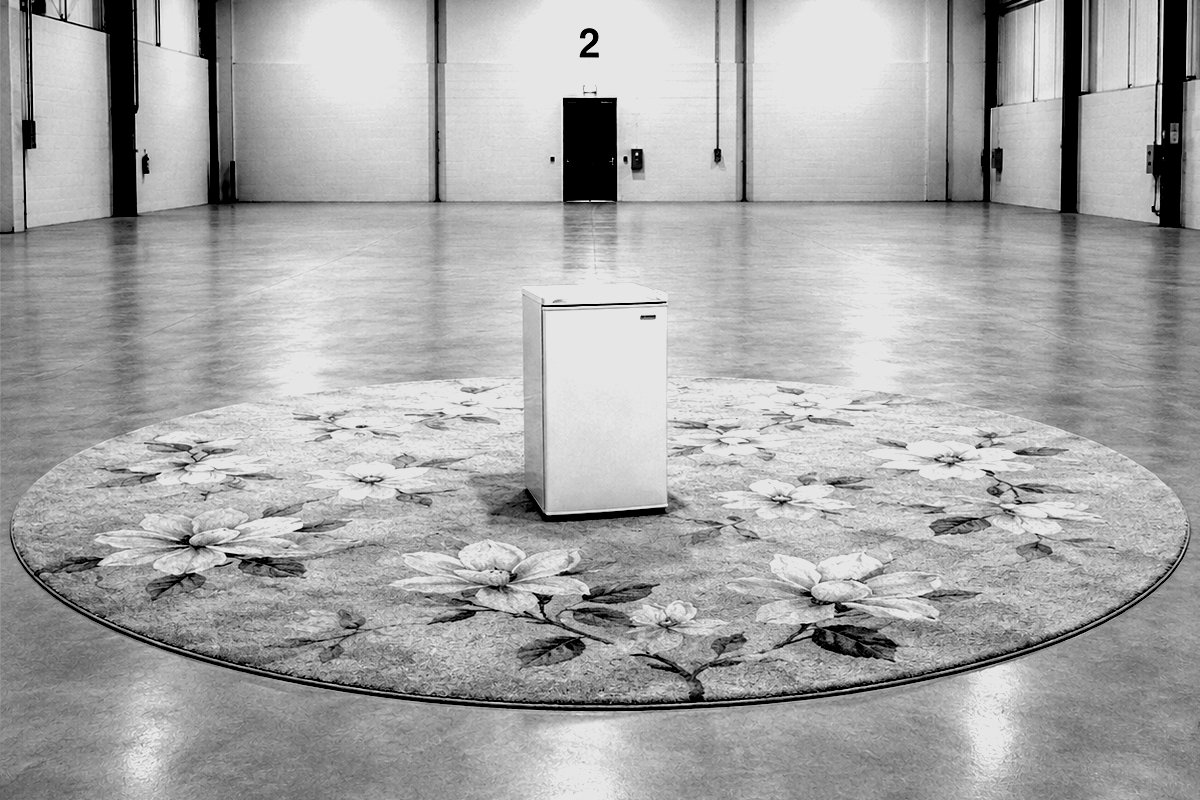
The carpet is magnolia. A circle, perhaps two metres in diameter, laid directly onto bare concrete. I stood in the doorway and looked at it for what I can only describe as a necessary amount of time. The contrast between the carpet and the floor — domestic warmth against industrial indifference, the softness of the home against the resistance of the space that has never been a home and does not pretend to be — was immediate. Was, I would say, the first thing the work asks of you. Are you paying attention? Are you here?
In the centre of the carpet: a refrigerator.
I want to dwell on the hum. I think it is essential and I think most critics will fail to address it with the seriousness it deserves. The hum of a refrigerator is one of the most intimate sounds in human experience. It is the sound of the home at rest. Three in the morning. The house breathing around you. The particular loneliness of being awake when nobody else is. Albrecht has not created this sound. He has simply placed it in a room, on a circle of magnolia carpet, on a concrete floor on an industrial estate in the outer reaches of Greater London, and asked you to hear it.
I heard it.
I think it's rather important to point out the soundscape when discussing Albrecht's work, and I don't wish to spoil it for you. I will only say that I must have spent at least twenty minutes standing in Room 1 with my eyes closed, simply listening. What I heard was not a fridge. What I heard was every kitchen I have ever stood in at three in the morning. What I heard was time passing in a place where nobody was watching it pass.
When I opened my eyes the magnolia carpet seemed different. Warmer. More present.
I moved slowly but expectantly toward Room 2.
Middle Rooms
Whilst I could describe to you the remaining rooms in greater detail, my commitment to this work and to your experience of it is absolute. To the outside observer — to those arriving without the necessary framework, without the years of engagement with the form that allow one to receive what is being offered — it may appear that each room presents a similar proposition. A carpet. A fridge. A hum. I understand why one might think this. I would ask those of you with a genuine appreciation for what Albrecht is doing to trust me when I say that these spaces are radically, irrecoverably different from one another, and that to describe them here would be to take something from you that you have not yet had the opportunity to possess.
What I will say is this: Room 3 stopped me.
I stood there for some time. The gallery assistant watched me. He said nothing. I said nothing. The fridge hummed.
I moved toward Room 5, and what was waiting for me there.

The Final Room
I want to tell you what I saw and I find, standing here now at my desk in Stoke Newington attempting to locate the correct words, that I cannot do it justice. I will try anyway. This is what critics do. We try.
There is a carpet. A circle, as in the rooms before it, laid onto concrete. And then there is nothing else.
No refrigerator.
I stood in the doorway for a long time. Longer, I think, than I stood anywhere else. The room was silent in a way that the preceding rooms had not been, and I do not mean simply that there was no hum — though there was no hum, and the absence of it was immediate and physical, like a pressure change, like something leaving a room just before you enter it. I mean that the silence was a different kind of silence. It was the silence of expectation unfulfilled. The silence of a space that knows what it is missing.
The carpet knows.
I understood, standing there, what Albrecht meant when he said those two words in that Lithuanian journal in 2015. I had thought I understood before. I had written about understanding. I had not understood.
I stood on the carpet. I want to be clear about this — I stepped onto it deliberately, which I had not done in the preceding rooms. Something asked me to. I stood in the centre of it, where the refrigerator was not, and I listened to the silence that the refrigerator had left behind, and I thought about every empty space I have ever stood in, every absence I have ever tried to name, every relationship I have ever watched end not with noise but with the particular quality of quiet that arrives when something that was always there simply isn't anymore.
I was there for quite some time.
The gallery assistant appeared in the doorway at one point. He looked at me. I looked at him. He retreated.
When I finally turned to leave I noticed, above the door behind me, a number.
2.
I had entered through a door marked 5. I was leaving through a door marked 2. I stood very still.
And then I understood the whole thing.
The Architecture of Return
I stood very still for what I can only describe as a necessary moment.
The door through which I had entered Room 5 was marked, above it, with the number 2. Not 5. Not the number I had arrived through from the other side. 2. Which meant that to walk back through it would be to enter Room 2. Which meant that the rooms did not end. They simply changed direction. Which meant that I had not, in any meaningful sense, finished.
I want to be careful here because I am aware that what I am about to say will sound, to certain readers, like a simple observation about door numbering. To those readers I would say only this: you are not wrong, and I hope one day something stops you in a doorway the way this stopped me.
The sequence I had walked — 1, 2, 3, 4, 5 — was not a sequence at all. It was a proposition. Walk far enough in one direction and you find yourself at the beginning of another. The numbers do not end. They reset. The journey you thought you were completing is the journey you are about to begin again, from the other side, with different eyes.
Room 5 has no exit.
Room 5 has no fridge.
Room 5 has a carpet the colour of something I will not describe, and a door marked 2, and a silence where a hum should be, and nothing else.
It is, in my considered assessment after eleven years of following this practice, the most complete thing Petoy Albrecht has ever made.
Cold is at The Void until the 14th of next month. Access is by invitation only. If you have not received an invitation I would encourage you to examine why that might be, and what it might suggest about the work you have done — or not done — to place yourself in proximity to art that matters.
I received my invitation. I got in a car. I stood on a carpet in an industrial unit in a postcode I will not disclose and listened to a silence that I will not forget.
I hope you get the chance to do the same.
I rather suspect most of you won't.
Correspondence
Sign in to leave a comment.